 Loading... Please wait...
Categories
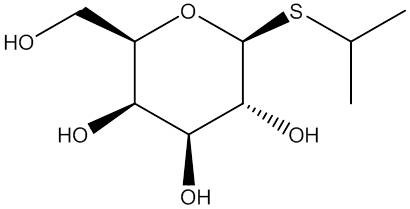


Isopropyl-beta-D-thiogalactoside (IPTG)
(isopropyl-β-D-thiogalactopyranoside; IPTG dioxane free)
Purity > 99.0 %
Molecular Biology Grade, synthetically made and not from animal origin
| CAS Number: |
367-93-1
|
| Chemical Formula: | C9H18O5S |
| Molecular Weight: | 238.3 g/mol |
IPTG, dioxane free is an analog of lactose that inactivates the lac repressor resulting in IPTG induction. The lac repressor is a DNA binding protein that inhibits gene expression therefore you can think of IPTG operating by inhibiting an inhibitor thus allowing expression to occur. IPTG serves as a mimic of the naturally occurring allolactose that is an inducer of the lac operon. This is commonly referred to as IPTG induction and used in protein expression.
IPTG cannot be hydrolyzed or broken down by the E. coli therefore the concentration remains constant during cell replication. IPTG is often used at a final concentration ranging from 0.5-1.0 mM. X-Gal is often used with IPTG since it provides an easy visual method to monitor whether protein expression has occurred. X-Gal as the name implies contains a galactose group that once metabolized causes a bright blue color change.
Free Shipping within the Continental USA
IPTG Certification of Analysis
| Test | Results |
| Appearance | White crystalline powder |
| Solution (1% in Water) | Colorless, clear |
| IR | Corresponds to Reference |
| Melting Point | 111.4°-113.2 °C |
| Assay (IC) | 99.6 % (HPLC) |
| Dioxane Content | < 1 ppm (GC) |
Stock Solution Preparation of 1 M IPTG (1 M IPTG Recipe)
- Dissolve 2.38 g of IPTG in 8 mL of distilled H2O.
- Bring to a final volume of 10 mL with molecular biology grade H2O.
- Filter sterilize with a 0.22 μ syringe filter.
- Store in 1mL aliquots at -20 °C.
View this method on protocols.io and use it directly at your bench
Comparable Items:
| Alfa Aesar | B21149-06 |
| Alfa Aesar | B21149-03 |
| Amresco | E708-1ML |
| Amresco | 0487-100G |
| Amresco | J436-100G |
| Amresco | N714-10ML |
| Amresco | N679-10G |
| Amresco | 0428-1G |
| Amresco | N679-1G |
| Amresco | 0487-10G |
| Amresco | N714-1.5ML |
| Amresco | 0428-100MG |
| Amresco | 0487-1G |
| Avantor | V263-01 |
| Bachem | Q-2060.0005 |
| Bachem | Q-2060.0025 |
| EMD Millipore | 420322-10GM |
| EMD Millipore | 420322-25GM |
| EMD Millipore | 5820-100GM |
| EMD Millipore | 5810-5GM |
| EMD Millipore | 420322-1GM |
| EMD Millipore | 420322-5GM |
| EMD Millipore | 5815-25GM |
| IBI Scientific | IB02125 |
| IBI Scientific | IB02105 |
| Ken-A-Vision | 2100 |
| MP Biomedicals | 10210101 |
| MP Biomedicals | 10210105 |
| TCI America | I0328-5G |
| TCI America | I0328-1G |
Celebrity Endorsements
Aktas, et. al. Proper Positioning of the Nicotinamide Ring Is Crucial for the Ascaris suum Malic Enzyme Reaction. Biochemistry, 2008, 47 (8), 2539–2546.
Derewenda, Z. S. (2004) The use of recombinant methods and molecular engineering in protein crystallization. Methods. Vol 34. 354–363.
Add to Wish List
Let's Stay in Touch
Recently Viewed...

Terms of Service & Privacy Policy | Sitemap | P212121 Company Information | Accessibility Statement
Products are for research use only and are not intended for human use. We do not sell to patients or the public. Buyers must be employeed by scientific research companies or universities.
WARNING: Products sold can expose you to chemicals including lead, which is known to the State of California to cause cancer, birth defects, and/or other reproductive harm. For more information, go to www.P65Warnings.ca.gov.
All prices are in USD Copyright 2024 P212121, LLC.