 Loading... Please wait...
Categories
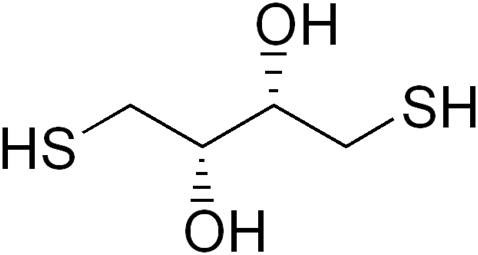


Dithiothreitol
(DTT; (D,L)-1,4-Dithiothreitol; DL-Dithiothreitol; Cleland's Reagent; Cleland Reagent; threo-2,3-dihydroxy-1,4-dithiolbutane)
Purity > 99.5 %
Molecular Biology Grade
| CAS Number: | 3483-12-3 |
| Chemical Formula: | C4H10O2S2 |
| Molecular Weight: | 154.25 g/mol |
Dithiothreitol is a commonly used reducing agent and is soluble in a range of solvents including water, ethanol, acetone and ethyl acetate. DTT is quite hygroscpoic and in some applications has been replaced by TCEP HCl. The use of dithiothreitol (DTT) was popularized by William Wallace Cleland who first published on its reducing potential in 1964. This led to dithiothreitol being referred to as Cleland's reagent. DTT has a reducing potential of -0.33 V at pH 7. DTT should only be used as a reducing agent above a pH 7 since the thiol group needs to deprotonated becoming a thiolate (S-) species. The thiolate group is responsible for breaking apart the disulfide bonds within proteins.
DTT is listed under two CAS numbers 27565-41-9 and 3483-12-3.
Store: -20 °C
Free within the Continental USA
Dithiothreitol Certification of Analysis
Manufacture and Expiration Data available upon request.
| Test | Speficiations | Results |
| Appearance | White crystalline powder | Corresponds |
| Absorbance (280 nm) | Colorless, clear | 0.1 Molar |
| % Oxidized DTT | 0.3 % | Conforms |
| Melting Point | 40-44 °C | 42 °C |
| pH 0.1 M | N/A | 4-6 |
| FTIR | Reference spectrum | Corresponds |
Preparation of 1 M Dithiothreitol (DTT) Stock Solution
- Dissolve 15.45 g of dithiothreitol in 100 mL of water to obtain a final concentration of 1 M (154.5 mg/mL).
- Aliquot into 1.6 mL tubes and store the tubes at -20 °C.
View this method on protocols.io and use it directly at your bench
Celebrity Endorsements
Wang, H.; Qi, M.; Cutler, A.J. (1993) A simple method of preparing plant samples for PCR. Nucleic Acids Research, Vol. 21, 4153-4154.
The standard Taq PCR buffer (1 x, consisting of 10 mM Tris, 50 mM KCl, 1.5 mM MgCl2, 0.01% gelatin and 3 mM DTT (dithiothreitol) with pH 8.3) were shown to produce good results. In regards to standard PCR buffer individual components of the following were explored: Tris (100 mm, pH 8.3) or KCI (500 mM) or MgCl2 (15 mM) or DTT (30 mM). Tris proved to be the most critical.
References Citing this Product:
Guo, L.W. (2007). Protein Expression and Purification, 51(2), 187-197.
Tan A.; et al. (2008). Energetics of OCP1–OCP2 complex formation. Biophysical Chemistry, 134 (1-2). 64-71.
Tan, A.; Henzl, M.T. (2009) Conformational stabilities of guinea pig OCP1 and OCP2. Biophysical Chemistry, 144. 3. 108-118.
Add to Wish List
Let's Stay in Touch
Recently Viewed...

Terms of Service & Privacy Policy | Sitemap | P212121 Company Information | Accessibility Statement
Products are for research use only and are not intended for human use. We do not sell to patients or the public. Buyers must be employeed by scientific research companies or universities.
WARNING: Products sold can expose you to chemicals including lead, which is known to the State of California to cause cancer, birth defects, and/or other reproductive harm. For more information, go to www.P65Warnings.ca.gov.
All prices are in USD Copyright 2024 P212121, LLC.